
This Privacy Policy describes our policies and procedures regarding the collection, use, and disclosure of your personal information when you use the Service, and explains your privacy rights and how the law protects you.
By using the Service, you agree to the collection and use of information in accordance with this Privacy Policy.
Universidad San Francisco de Quito (USFQ) continuously updates and adapts its institutional processes to ensure compliance with the Organic Law on Personal Data Protection and all other applicable regulations.
Please note that whenever the processing of personal data requires the data subject’s consent, USFQ will obtain it through the appropriate mechanisms established for each specific process, in accordance with applicable legal provisions.
Our communications are intended to keep our partners and collaborators informed about institutional activities, initiatives, and projects, as well as to encourage their participation and collaboration in the development of these initiatives.
If you prefer not to receive communications or information from USFQ, you may request to be removed from our mailing list by replying to this email at avivanco@usfq.edu.ec.
The personal data we collect will be retained only for as long as necessary to fulfill the purposes specified in each process or as required by law.
You may exercise your rights at any time, including the withdrawal of previously granted consent, by submitting a request to datos@usfq.edu.ec. For more information about how your data is processed and the protection measures implemented, please consult our Privacy Notice at Privacy Policy – Galápagos. Política de privacidad – Galápagos
Company refers to the Galapagos Science Center, data controller.
Service refers to www.galapagosscience.org.
Personal Data means any information relating to an identifiable individual.
Usage Data refers to data collected automatically.
You means the individual using the Service.
We may collect:
Name and email address
Contact and location data
Technical and usage information
Personal data is used to:
Provide and maintain the Service
Manage requests and communications
Institutional and informational communications
Improve functionality
Comply with legal obligations
We use essential and functional cookies to operate and improve the Service. You may disable cookies via your browser settings.
Personal data may be shared with service providers, institutional partners, or authorities when legally required.
We do not sell personal data.
Data is retained only as long as necessary for the stated purposes or legal compliance.
Your data may be processed outside your country of residence. Appropriate safeguards are applied.
You may request access, correction, deletion, objection, or withdrawal of consent by contacting datos@usfq.edu.ec.
U.S. residents, including California residents, have the right to:
Know what personal data is collected
Request deletion or correction
Opt out of data sharing
Non-discrimination for exercising rights
We do not sell or share personal data as defined under California law.
The Service is not intended for children under 13 years of age.
We are not responsible for third-party privacy practices.
This Privacy Policy may be updated at any time.
| Cookie | Duration | Description |
|---|---|---|
| cookielawinfo-checkbox-analytics | 11 months | This cookie is set by GDPR Cookie Consent plugin. The cookie is used to store the user consent for the cookies in the category "Analytics". |
| cookielawinfo-checkbox-functional | 11 months | The cookie is set by GDPR cookie consent to record the user consent for the cookies in the category "Functional". |
| cookielawinfo-checkbox-necessary | 11 months | This cookie is set by GDPR Cookie Consent plugin. The cookies is used to store the user consent for the cookies in the category "Necessary". |
| cookielawinfo-checkbox-others | 11 months | This cookie is set by GDPR Cookie Consent plugin. The cookie is used to store the user consent for the cookies in the category "Other. |
| cookielawinfo-checkbox-performance | 11 months | This cookie is set by GDPR Cookie Consent plugin. The cookie is used to store the user consent for the cookies in the category "Performance". |
| viewed_cookie_policy | 11 months | The cookie is set by the GDPR Cookie Consent plugin and is used to store whether or not user has consented to the use of cookies. It does not store any personal data. |
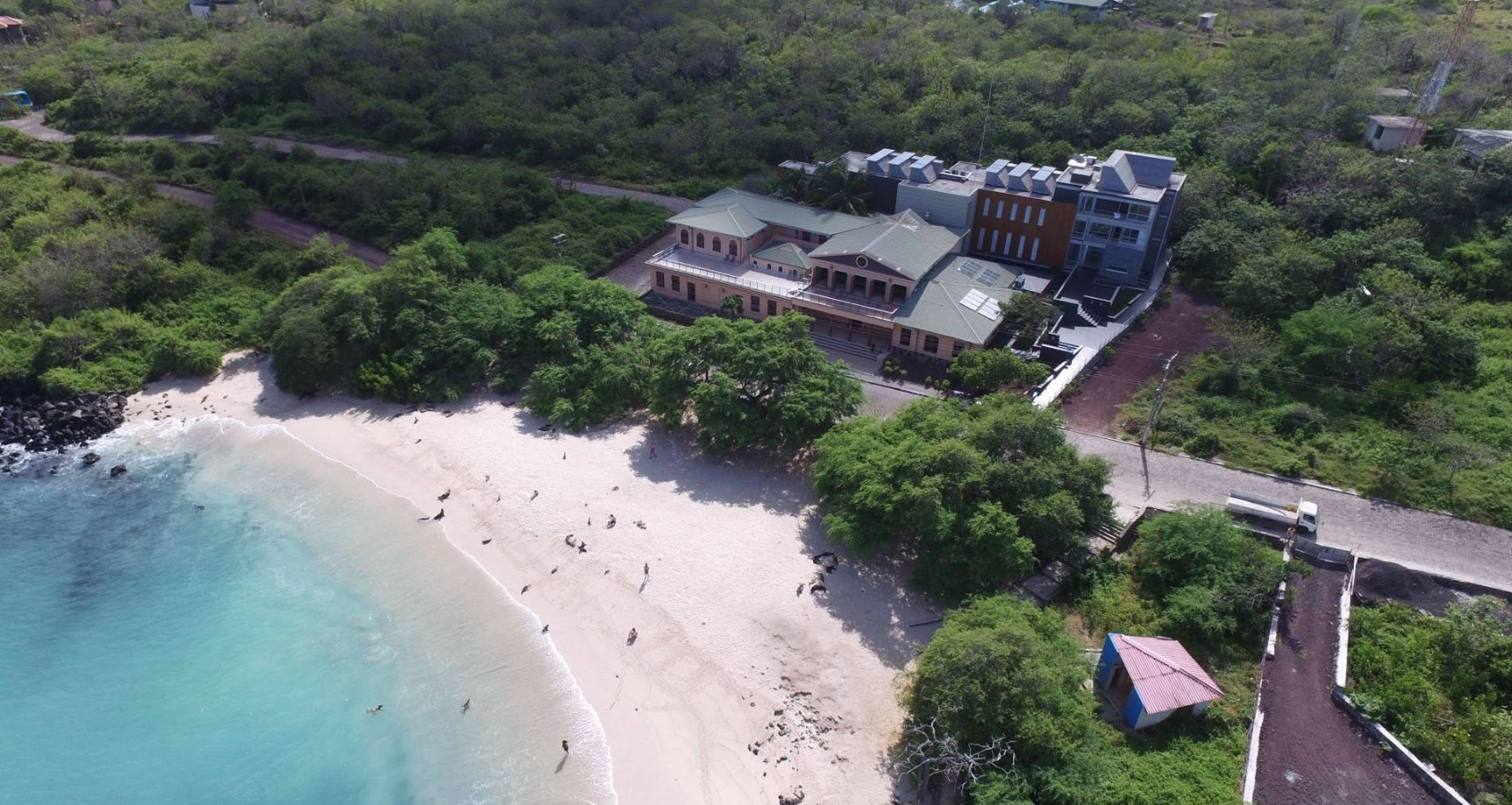
In 2022, the Galapagos Science Center (GSC) and the broader UNC & USFQ Galapagos Initiative will celebrate its 10th Anniversary. We are proud to announce the World Summit on Island Sustainability scheduled to be held on June 26–30, 2022 at the Galapagos Science Center and the Community Convention Center on San Cristobal Island.
The content of the World Summit will be distributed globally through social media and results documented through papers published in a book written as part of the Galapagos Book Series by Springer Nature and edited by Steve Walsh (UNC) & Carlos Mena (USFQ) as well as Jill Stewart (UNC) and Juan Pablo Muñoz (GSC/USC). The book will be inclusive and accessible by the broader island community including scientists, managers, residents, tourists, and government and non-government organizations.
While the most obvious goal of organizing the World Summit on Island Sustainability is to celebrate the 10th Anniversary of the GSC and the UNC-USFQ Galapagos Initiative, other goals will be addressed through special opportunities created as part of our operational planning of the World Summit.
For instance, we seek to elevate and highlight the Galapagos in the island conservation discourse, seeking to interact with other island networks in more obvious and conspicuous ways to benefit the Galapagos Islands, the UNC-USFQ Galapagos Initiative, and the world. We will seize the opportunity to further develop the I2N2 – International Islands Network-of-Networks. Further, we wish to highlight and emphasize multiple visions of a sustainable future for the Galapagos Islands and we cannot do this alone. Therefore, engaging the Ecuadorian Ministry of Environment, the Ministry of Tourism, the Government Council of Galapagos, the Galapagos National Park, and local Galapagos authorities, including government and non-government organizations and local citizen groups, is imperative.
Borrowing from Hawaii’s and Guam’s Green Growth Program and the Global Island Partnership, we wish to examine existing global programs that emphasize island sustainability and their incorporation into life, policies, and circumstances in the Galapagos Islands. We will also seek to enhance our connections with the institutional members of our International Galapagos Science Consortium and expand the Consortium through the recruitment of other member institutions. We will also work to benefit islands and their local communities by working with citizen groups as well as important NGOs who seek to improve the natural conditions in the Galapagos and diminish the impact of the human dimension on the future of Galapagos’ ecosystems.
Lastly, we will use the World Summit to benefit UNC & USFQ and our constituencies through a strong and vibrant communication plan about the World Summit, creating corporate relationships as sponsors, identifying funding goals through donors, and benefiting our study abroad program for student engagement in the Galapagos Islands. We plan to develop and issue a Galapagos Sustainability Communique after the World Summit that includes the vision and insights of all its participants for a sustainable Galapagos with applicability to global island settings.
We are eager to hear your perspective and have you join us at the World Summit on Island Sustainability!