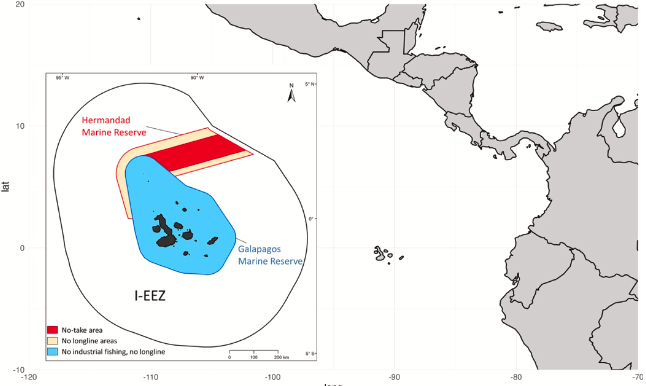
Industrial fishing in waters near the Galápagos has long been a challenge for marine conservation. In a context where fishing pressure and species protection coexist in tension, a recent study examined what happens when new marine protected areas are implemented. In particular, the creation of the Hermandad Marine Reserve in 2022 offers a unique opportunity to understand how fishing fleets respond to new regulations in one of the most biodiverse regions on the planet.
The objective of the study was to assess industrial fishing patterns within Ecuador’s Insular Exclusive Economic Zone, including the Galápagos Marine Reserve and the newly established Hermandad Reserve. Through this analysis, researchers sought to understand how fishing effort varies across management zones, which fishing methods are most prevalent, and how fleet behavior changed before and after the implementation of this new protected area.
To achieve this, satellite-based vessel positioning data (AIS) collected between 2019 and 2023 were used, along with analytical tools and statistical models. This approach made it possible to identify more than 145 industrial vessels from 10 countries and estimate over 64,000 hours of fishing activity in the region. Variables such as gear type, spatial distribution, and temporal changes in activity were also analyzed, allowing for a precise evaluation of the new marine reserve’s impact.
The results reveal a key finding: following the creation of the Hermandad Marine Reserve, fishing effort within this area decreased by 88%. This significant change suggests a high level of compliance, even without an immediate increase in enforcement measures. Unlike other cases, there was no clear displacement of fishing activity to nearby areas. Overall, the study concludes that a combination of international visibility, stakeholder agreements, and prior regional management may be critical to achieving effective conservation, positioning the Galápagos as a benchmark for sustainable ocean management.
Read the article here: https://www.sciencedirect.com/science/article/abs/pii/S0308597X25003847