
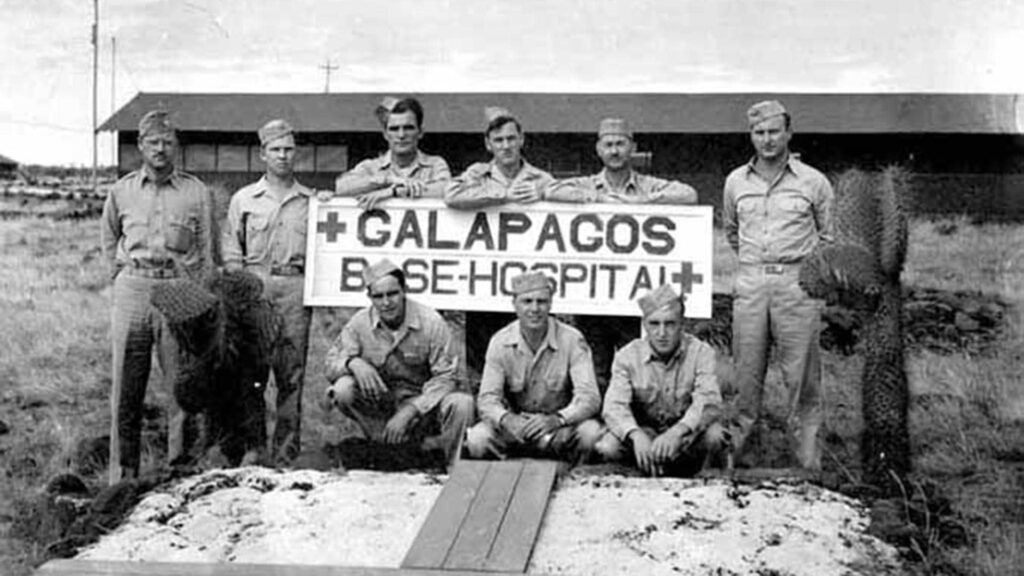
Reconstrucción digital de la base estadounidense en Baltra, Islas Galápagos: un capítulo olvidado de la Segunda Guerra Mundial en Sudamérica

La historia contemporánea de Galápagos incluye episodios poco conocidos que contrastan con la imagen actual del archipiélago como un santuario natural. Uno de ellos se sitúa en la isla Baltra, donde, durante la Segunda Guerra Mundial, se instaló una base militar estadounidense de gran escala como parte de una estrategia para proteger el Canal de Panamá. Esta intervención transformó de manera significativa el territorio y sus ecosistemas. Con el paso del tiempo, gran parte de esta infraestructura fue desmontada o quedó en abandono, dejando huellas que hoy apenas son visibles.

Con el propósito de recuperar este capítulo histórico y comprender su alcance, un equipo de investigación del Galapagos Science Center desarrolla una reconstrucción digital en tres dimensiones de la base militar tal como existía entre 1942 y 1946.

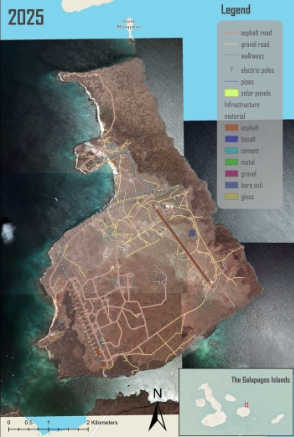
El estudio integra diversas fuentes de información, incluyendo fotografías aéreas históricas, mapas, registros documentales, imágenes satelitales y levantamientos de campo con drones. Esto permite identificar y mapear más de 600 estructuras, así como analizar los cambios en el uso del suelo a lo largo de varias décadas. Los resultados evidencian tanto la magnitud de la ocupación humana en ese periodo como la progresiva desaparición de gran parte de la infraestructura original.
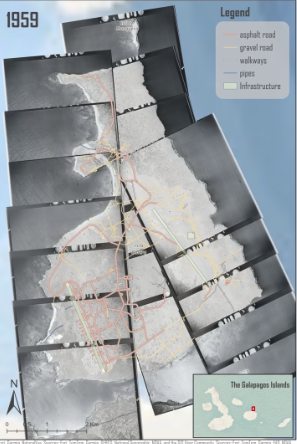
Más allá de la reconstrucción histórica, la investigación demuestra la capacidad de recuperación del entorno natural. Actualmente, gran parte de la isla presenta signos de regeneración ecológica, con la presencia de especies nativas que recolonizan áreas previamente intervenidas. El modelo digital no solo constituye un aporte al conocimiento científico, sino también una herramienta valiosa para la educación, la conservación y la interpretación del patrimonio.
Lee la investigación completa aquí: https://doi.org/10.5194/isprs-archives-XLVIII-3-W4-2025-71-2026

Recent Posts

In 2022, the Galapagos Science Center (GSC) and the broader UNC & USFQ Galapagos Initiative will celebrate its 10th Anniversary. We are proud to announce the World Summit on Island Sustainability scheduled to be held on June 26–30, 2022 at the Galapagos Science Center and the Community Convention Center on San Cristobal Island.

The content of the World Summit will be distributed globally through social media and results documented through papers published in a book written as part of the Galapagos Book Series by Springer Nature and edited by Steve Walsh (UNC) & Carlos Mena (USFQ) as well as Jill Stewart (UNC) and Juan Pablo Muñoz (GSC/USC). The book will be inclusive and accessible by the broader island community including scientists, managers, residents, tourists, and government and non-government organizations.

While the most obvious goal of organizing the World Summit on Island Sustainability is to celebrate the 10th Anniversary of the GSC and the UNC-USFQ Galapagos Initiative, other goals will be addressed through special opportunities created as part of our operational planning of the World Summit.

For instance, we seek to elevate and highlight the Galapagos in the island conservation discourse, seeking to interact with other island networks in more obvious and conspicuous ways to benefit the Galapagos Islands, the UNC-USFQ Galapagos Initiative, and the world. We will seize the opportunity to further develop the I2N2 – International Islands Network-of-Networks. Further, we wish to highlight and emphasize multiple visions of a sustainable future for the Galapagos Islands and we cannot do this alone. Therefore, engaging the Ecuadorian Ministry of Environment, the Ministry of Tourism, the Government Council of Galapagos, the Galapagos National Park, and local Galapagos authorities, including government and non-government organizations and local citizen groups, is imperative.

The Galapagos Science Center on San Cristobal Island, Galapagos

Borrowing from Hawaii’s and Guam’s Green Growth Program and the Global Island Partnership, we wish to examine existing global programs that emphasize island sustainability and their incorporation into life, policies, and circumstances in the Galapagos Islands. We will also seek to enhance our connections with the institutional members of our International Galapagos Science Consortium and expand the Consortium through the recruitment of other member institutions. We will also work to benefit islands and their local communities by working with citizen groups as well as important NGOs who seek to improve the natural conditions in the Galapagos and diminish the impact of the human dimension on the future of Galapagos’ ecosystems.

Lastly, we will use the World Summit to benefit UNC & USFQ and our constituencies through a strong and vibrant communication plan about the World Summit, creating corporate relationships as sponsors, identifying funding goals through donors, and benefiting our study abroad program for student engagement in the Galapagos Islands. We plan to develop and issue a Galapagos Sustainability Communique after the World Summit that includes the vision and insights of all its participants for a sustainable Galapagos with applicability to global island settings.

We are eager to hear your perspective and have you join us at the World Summit on Island Sustainability!